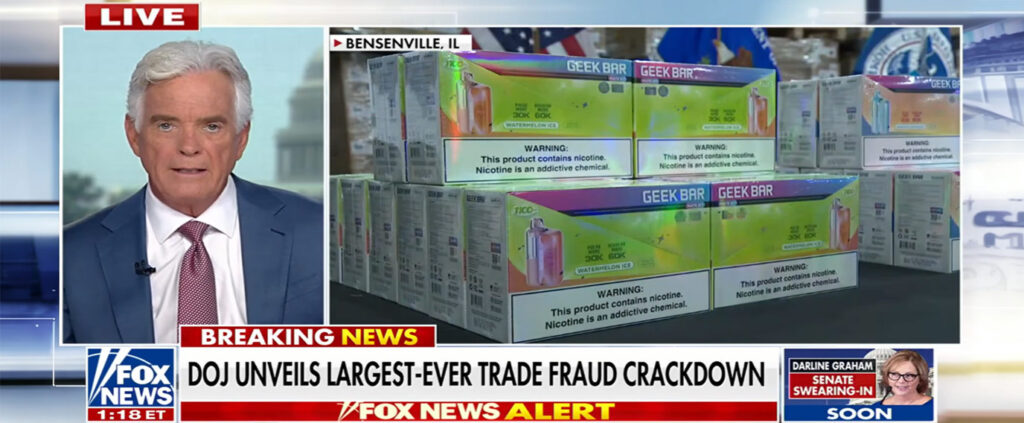
As reported by 2Firsts, the U.S. Department of Justice (DOJ) announced that its Trade Fraud Task Force (TFTF), launched in August 2025 with the Department of Homeland Security (DHS), has surpassed $1 billion in civil and criminal recoveries, penalties, forfeitures, and publicly charged losses in less than one year.
The DOJ stated that the TFTF was established to investigate and prosecute companies and individuals that defraud the U.S. government through material misrepresentations to U.S. Customs and Border Protection (CBP), including illegal transshipment, mislabeling, false declarations, and tariff evasion. The DOJ further emphasized that trade fraud enforcement is no longer limited to the point of entry, as TFTF investigations may extend across the entire supply chain, including importers, customs brokers, downstream distributors, industrial and commercial end-users, and other businesses involved in imported goods.
Although the DOJ Trade Fraud Task Force announcement is not a direct enforcement action against disposable vapes, it highlights a broader shift in U.S. trade oversight. For industries that rely heavily on overseas manufacturing and global supply chains, including the vape industry, accurate import declarations, verified product origins, and supply chain transparency are becoming increasingly critical.
Table of Contents
How U.S. Import Compliance Changes Could Impact Disposable Vapes

The vape industry cannot ignore the increasing focus on import compliance and trade enforcement. Vape products, including disposable vapes and pod systems, rely heavily on global supply chains involving multiple stages before reaching U.S. consumers.
A disposable vape sold in the U.S. is rarely produced by a single company. Behind a single device, there may be overseas manufacturers, battery and chipset suppliers, packaging companies, logistics providers, U.S. importers, distributors, and retailers.
For years, most vape compliance discussions have centered on whether products can legally be marketed and sold, including FDA requirements, state regulations, product restrictions, and sales rules. However, recent trade enforcement efforts are shifting attention toward the supply chain behind the product itself. This shift highlights the growing importance of disposable vape supply chains, where every stage — from manufacturing and component sourcing to import and distribution— may affect overall compliance.
For disposable vape brands and importers, factors such as manufacturing location, country of origin, supplier information, and import documentation may face increased scrutiny. Companies may need to strengthen supply chain compliance processes to verify manufacturing details, ensure accurate origin declarations, confirm that import information matches actual products, and maintain reliable supplier documentation.
What Could Stricter U.S. Import Enforcement Mean for Vapers

For everyday vapers, these changes are unlikely to happen overnight. The DOJ announcement does not mean disposable vapes will suddenly disappear from stores or that vapers will immediately lose access to their favorite products. Instead, the impact is more likely to appear gradually as companies adjust their supply chains and compliance processes.
One possible impact could be higher prices for some disposable vapes. Stronger import compliance may require companies to invest more resources in documentation, supplier verification, customs procedures, and compliance processes. Some of these additional costs could eventually affect retail pricing, especially for lower-margin products.
Vapers may also notice changes in product availability. Brands with weak supply chain management or limited compliance records could face more challenges maintaining stable product supply, while those with transparent supply chains and strong compliance systems may be positioned to adapt to the changing market. In some cases, vape store owners may prioritize products from suppliers that can provide clearer documentation and more reliable compliance records.
For vapers, this shift is more than just another industry update — it marks the beginning of a broader change toward greater supply chain accountability in the vape market. As U.S. trade enforcement places greater emphasis on accurate import information and supply chain transparency, brands that invest in compliance may have a stronger advantage in maintaining market access. Most vapers will likely continue purchasing their preferred products, but the industry could gradually evolve as companies adapt to these changing requirements.