
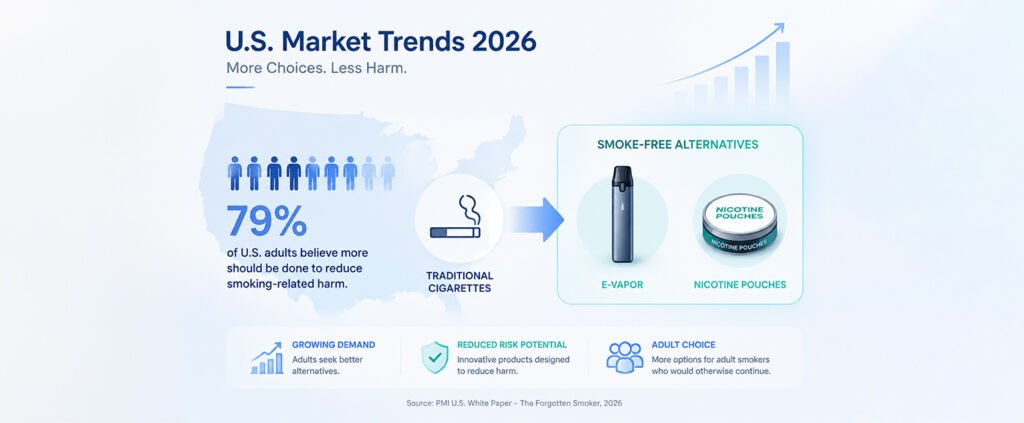
In a nationwide survey cited by Philip Morris International U.S. (PMI U.S.), 79% of American adults believe more should be done to reduce smoking-related harm. In response, PMI released a white paper titled The Forgotten Smoker: Modern Solutions to America’s Oldest Public Health Challenge, calling for renewed focus on cigarette smoking as a core public health issue in the United States.
Adult Smokers and “Forgotten Smokers”
The white paper emphasizes that certain adult smokers, described as “forgotten smokers”, remain disconnected from traditional anti-smoking campaigns and continue to face health risks from cigarettes.
The survey showed that 53% of respondents agree that adults who still smoke should be encouraged to switch to smoke-free nicotine alternatives.
These smoke-free alternatives are generally understood in the industry to include electronic cigarettes (vapes), nicotine pouches such as ZYN, On!, as well as other smoke-free nicotine products available in the U.S. market.
From a market perspective, these products are increasingly viewed not only as cessation tools, but also as alternatives to cigarette consumption among adult smokers.
Public Perception, Education and Regulatory Context
The survey highlighted significant misconceptions about nicotine and tobacco product risks:
- 52% incorrectly believe nicotine directly causes cancer
- 73% think all tobacco and nicotine products are equally harmful to the user
- 70% believe all such products pose the same public health risk
Such findings suggest that misunderstandings about nicotine may influence adult perceptions of lower-risk, smoke-free alternatives.
The white paper recommends that public health authorities, such as the FDA, provide clear, science-based information on the relative harms of tobacco and nicotine products, especially to healthcare professionals and policymakers.
Importantly, the report also notes that the FDA currently faces a backlog of smoke-free product applications, and emphasizes the need for clearer communication regarding which products have received authorization and how their relative risks should be understood.
Policy Recommendations and Market Implications
PMI U.S. white paper outlines several key policy recommendations:
- Expand access to FDA-authorized smoke-free alternatives
- Implement risk-based taxation
- Strengthen youth-access prevention and enforcement against illicit products
In addition, PMI executives noted that although smoking rates in the United States continue to decline, millions of adults still face health risks associated with cigarettes.
They further emphasized that reducing cigarette smoking will require timely FDA review processes, expanded access to smoke-free alternatives, and clearer communication of harm-reduction information.
From an industry perspective, smoke-free categories such as disposable vapes, pod systems, and nicotine pouches continue to be widely discussed among adult nicotine consumers.
Recommended Smoke-Free Products
As smoke-free alternatives continue gaining attention in public-health and policy discussions, several product categories have become increasingly visible within the U.S. nicotine market. These categories are commonly used in industry analysis and reflect broader segmentation based on product type, nicotine delivery, and usage patterns.
Vapor Products (Electronic Nicotine Delivery Systems, ENDS)
Vapor products deliver nicotine via aerosolized e-liquid without combustion, commonly known as ENDS. This category includes disposable vapes and rechargeable pod-based systems. These devices are widely used by adults seeking smoke-free alternatives to cigarettes.
Usage & User Patterns
- Cigarette switchers
- Convenience-driven users
- Flavor-oriented users
Disposable Vapes
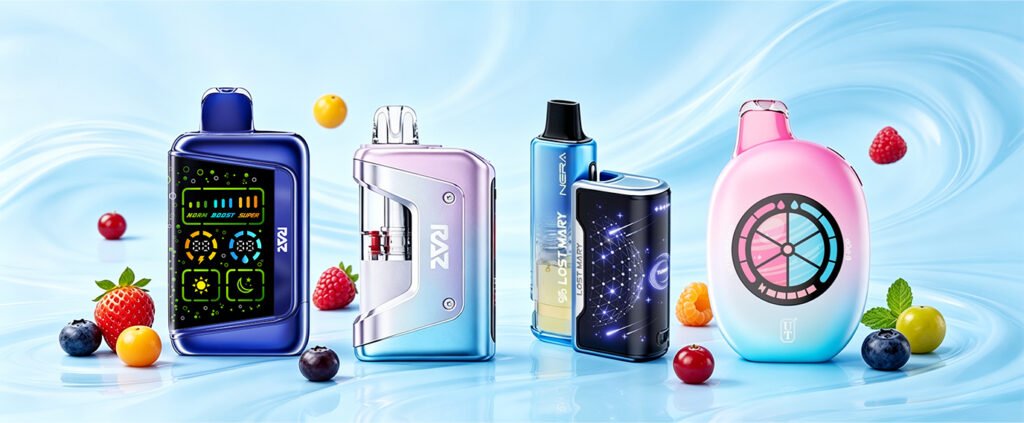
Disposable vapes are single-use or limited-lifecycle vapor devices with pre-filled e-liquid and integrated batteries. Popular for their simplicity and low barrier to entry.
Representative Products:
- RAZ RX50K Dew Edition — 19mL e-liquid capacity, up to 50K puffs, triple power modes, dual mesh coil, adjustable airflow, and LED display
- Lost Mary Nera Fullview — 24mL capacity, up to 70K puffs, reusable battery dock, dual mesh coil, and dual Normal/Turbo modes
- Flum UT Bar 50K — dual-tank design, up to 50K puffs, rechargeable battery, mesh coil system, and draw-activated operation
- RAZ Vue 50K — 13mL replaceable pod-based architecture, up to 50K puffs, 900mAh detachable battery, and dual mesh coil performance
These products are generally associated with convenience-driven growth trends within the vapor category.
Pod Systems and Pod Mods
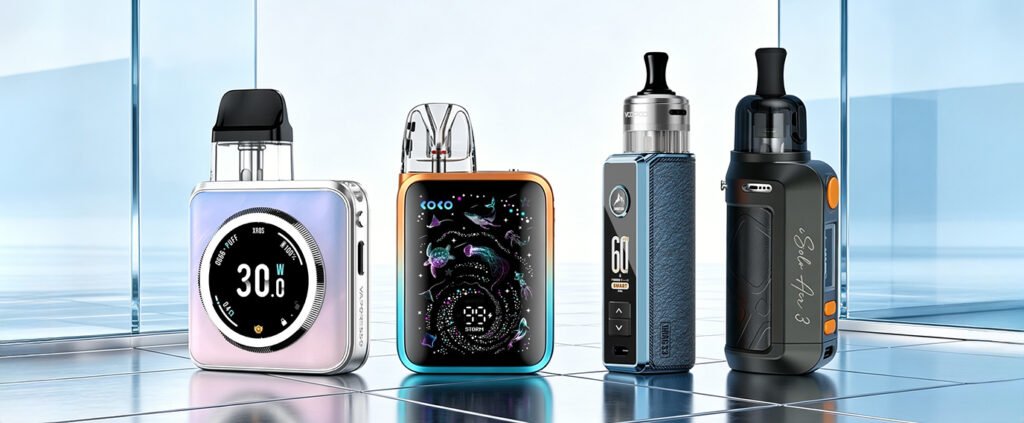
Pod systems are rechargeable closed-system devices that use pre-filled or refillable pods. Pod mods combine pod convenience with higher power and customization.
Usage & User Patterns
- Long-term nicotine users
- Disposable vape upgraders
- Stability-focused users
Representative Devices:
- Vaporesso XROS 5 Nano — 1600mAh battery, up to 30W output, 1.09” touchscreen display, COREX 3.0 coil technology, adjustable airflow, and intelligent output modes (Eco/Normal/Power)
- Uwell Caliburn G5 KOKO — 1600mAh battery, up to 35W output, PRO-FOCS 4.0 flavor technology, adjustable airflow, Caliburn G-series cartridge compatibility, and draw-activated firing
- VOOPOO Drag S3 — 3000mAh battery, up to 60W output, GENE.TT chipset, SMART/RBA/ECO power modes, PnP X coil platform compatibility, and adjustable airflow
- Eleaf iSolo Air 3 — 1500mAh battery, up to 40W output, GTL coil compatibility, adjustable airflow, TFT display screen, and single-button activation
Pod systems continue attracting adult users seeking longer-term alternatives to disposable products.
Oral Nicotine Products (Nicotine Pouches)
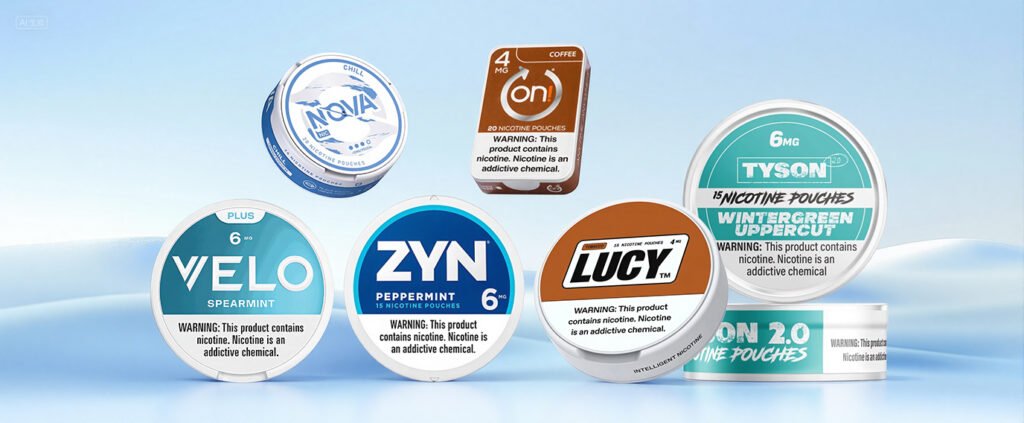
Nicotine pouches are tobacco-free oral nicotine products placed under the upper lip for nicotine absorption. Known for discreet and smoke-free usage.
Usage Scenarios:
- Workplaces with vaping restrictions
- Travel environments
- Indoor smoke-free spaces
Representative Brands:
- ZYN — Wintergreen, Peppermint, Smooth, Coffee, Chill, Menthol, Cool Mint, Citrus, Spearmint, Cinnamon, Espresso Martini
- On! — Coffee, Original, Citrus, Wintergreen, Mint, Cinnamon
- Nova — Berry, Cool Mint, Smooth, Clear, Menthol, Chill
- Lucy — Tobacco, Espresso, Wintergreen, Mango, Apple Ice, Berry Citrus, Mint
- Velo Plus — Spearmint, Peppermint, Wintergreen, Mint, Citrus Chill, Wild Berry, Dragon Fruit, Tropical Heat, Smooth, Cappuccino
- Tyson 2.0 — Citrus Hook, Mint Brawler, Original Haymaker, Wintergreen Uppercut
Flavor diversification and higher nicotine-strength options continue contributing to rapid growth within the oral nicotine category.
Other Emerging Smoke-Free Products
Beyond vapor and oral nicotine categories, new smoke-free categories continue to emerge within the U.S. nicotine market.
Examples:
- Heated tobacco products (HTP), such as IQOS-type systems
- Hybrid nicotine delivery systems
- Next-generation non-combustion nicotine formats under development
Although still evolving in regulatory status and market penetration, these products reflect ongoing innovation in non-combustible nicotine delivery systems.
Conclusion
Although U.S. smoking rates continue to decline, millions of adults still face health risks from cigarettes. White paper recommendations — expanding FDA-authorized smoke-free alternatives, improving harm communication, and implementing risk-based taxation — highlight a growing relevance for products like electronic cigarettes and nicotine pouches in harm-reduction strategies.
Market trends suggest that, combined with policy support and clearer consumer education, these smoke-free alternatives will remain a key consideration for adult smokers seeking potentially lower-risk alternatives compared with combustible cigarettes.







Leave a reply
Leave a reply