Introduction
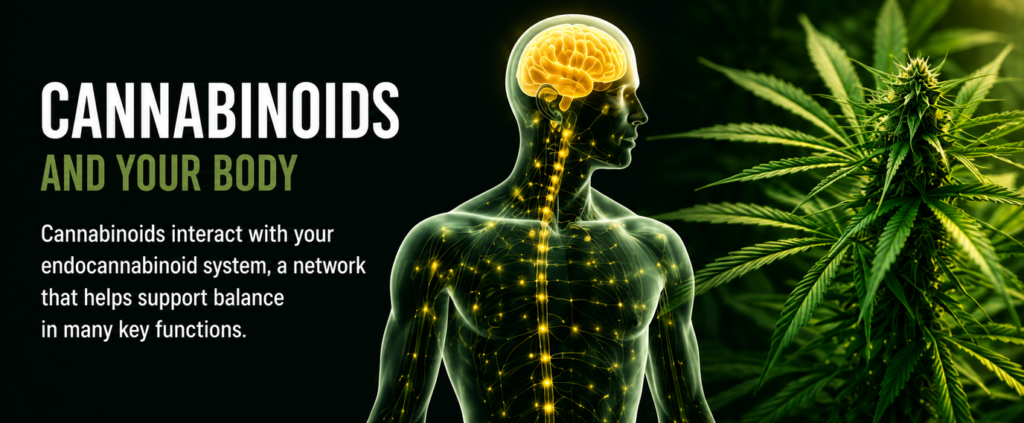
How Cannabinoids Work in the Body is closely connected to the endocannabinoid system, a network that helps support balance in areas like mood, sleep, appetite, pain response, and immune function. When cannabinoids enter the body, they may interact with cannabinoid receptors and influence how certain signals are sent between cells.
The short answer is that cannabinoids interact with a built-in system in the body known as the endocannabinoid system. That system plays a part in keeping different functions in balance, and cannabinoids appear to affect it in different ways depending on the compound, the amount, and the person using it.
What Are Cannabinoids?
Cannabinoids are compounds found in cannabis and hemp plants. Some are naturally produced by the plant, and some are also made by the human body in its own form. These compounds are often grouped together because they interact with the same general system, but that does not mean they all behave the same way.
That is why a product built around CBD may feel very different from one built around THC, and why blends with minor cannabinoids can create a different overall profile again.
The Endocannabinoid System in Simple Terms
The body has a system called the endocannabinoid system, often shortened to ECS. This system is made up of signaling compounds, receptors, and enzymes. It is thought to be involved in helping the body maintain internal balance across a range of everyday functions.
People often describe the ECS as a kind of balancing system. That does not mean it controls everything directly, but it does seem to be linked to how the body responds to things like stress, mood, appetite, sleep, discomfort, and other normal processes.
This is the reason cannabinoids get so much attention. They do not just enter the body and sit there. They interact with a system that is already active.
The Two Receptors People Hear About Most
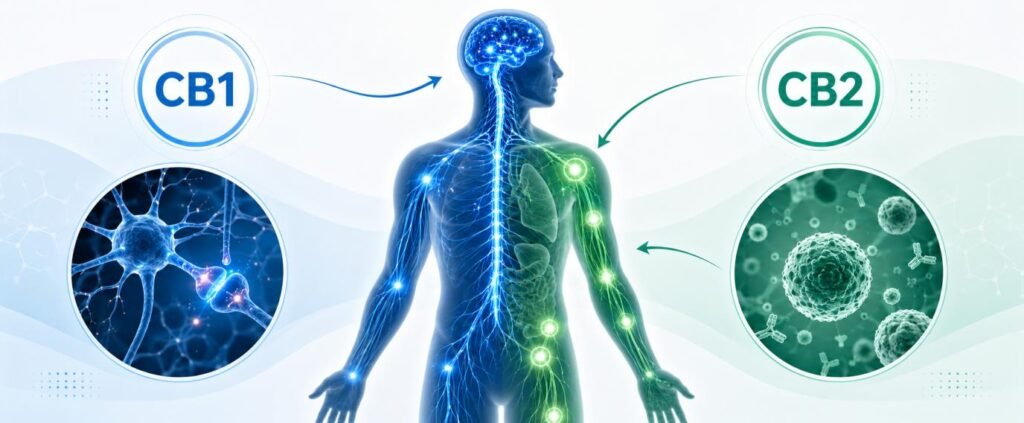
When people talk about cannabinoids and the body, two receptor types usually come up first: CB1 and CB2.
CB1 Receptors
CB1 receptors are mostly associated with the brain and central nervous system. They are often discussed in relation to mood, memory, coordination, and the more noticeable mental effects linked with certain cannabinoids.
CB2 Receptors
CB2 receptors are more often associated with the immune system and peripheral areas of the body. They are usually mentioned in discussions around broader body response and physical balance rather than stronger mental effects.
These two receptor types are part of why cannabinoids can feel different depending on where and how they interact. NIDA’s endocannabinoid system research offers more background on how cannabinoid signaling is studied in relation to health effects.
How the Body’s Own Cannabinoids Fit In
The body also makes its own cannabinoid-like compounds, often called endocannabinoids. These are not taken from a plant. They are produced naturally within the body and are part of the ECS itself.
Their role is often described as helping the body send signals where needed, then being broken down once that work is done. In that sense, plant cannabinoids are entering a system that already knows how to work with similar compounds.
That does not mean plant cannabinoids behave exactly the same way as the body’s own versions, but it does help explain why they are able to affect the system at all.
Minor Cannabinoids and Why They Matter
As the category has expanded, more attention has gone to compounds such as CBG, CBN, and other minor cannabinoids. These are often included in blends rather than being the only active focus of a product.
Part of the appeal is that cannabinoid products are no longer limited to one or two familiar names. Brands are now building products around different combinations, and users are becoming more aware that the overall effect may come from more than a single ingredient.
That is also why labels matter. Two products may both mention cannabinoids, but the actual formula can be very different.
Why Product Format Changes the Experience
The way a cannabinoid enters the body can also shape the overall experience

Vapes
Vape products are often chosen by people who want a format that feels fast and easy to use. Because inhaled products enter the body differently, the overall experience may feel more immediate.
Gummies and Edibles
Edibles usually follow a different pace. They are often chosen for convenience and measured portions, but the way they are processed by the body is different from inhaled formats.
Oils and Tinctures
These are often used by people who want a middle ground between convenience and flexibility. They can feel more adjustable, especially for users who want closer control over quantity.
So even when the cannabinoid itself is the same, the product format can still change how the experience feels from start to finish.
For product safety and approval status, the FDA cannabis and CBD regulation page gives the clearest official guidance.
Why Dose and Body Chemistry Matter
Cannabinoids do not affect everyone in exactly the same way. Body size, tolerance, previous experience, individual sensitivity, and the amount used can all change the result.
That is why two people can use similar products and come away describing them differently. It is also why the label alone does not tell the full story. The cannabinoid matters, but so do the dose, the format, and the person.
Full Spectrum, Broad Spectrum, and Isolate
These terms often appear on cannabinoid products, especially those built around CBD.
Full Spectrum
Full spectrum usually refers to a product that contains a wider range of cannabinoids and related plant compounds.
Broad Spectrum
Broad spectrum usually suggests a wider cannabinoid profile as well, but with a more selective composition.
Isolate
An isolate is more focused on one cannabinoid only, rather than a broader combination.
This matters because a product built around one isolated compound may feel different from one built around a broader mix, even when the main cannabinoid on the front label looks familiar.
Conclusion
Cannabinoids work in the body by interacting with a system that is already there. That system, the endocannabinoid system, helps explain why compounds like CBD, THC, CBG, and CBN can all belong to the same family while still feeling very different in use.
Once that part becomes clearer, cannabinoid products start to make more sense. The label matters, the formula matters, and the format matters. But underneath all of that is the same basic idea: cannabinoids influence the body by interacting with a system designed to respond to similar compounds in the first place.
FAQs
1. What does the endocannabinoid system do?
It is generally described as a system involved in helping the body maintain balance across a range of normal functions.
2. Do all cannabinoids work the same way?
No. They belong to the same broad category, but different cannabinoids appear to interact with the body in different ways.
3. Why does THC feel different from CBD?
THC is more commonly linked with direct interaction that can produce noticeable intoxicating effects, while CBD is usually described as working in a less direct way.
4. Does the product format matter?
Yes. A vape, gummy, oil, or capsule may feel different even when the cannabinoid itself is similar, because the body processes each format differently.
5. Is one cannabinoid always better than another?
Not really. It usually depends on the product, the formula, the amount, and the kind of experience someone is looking for.