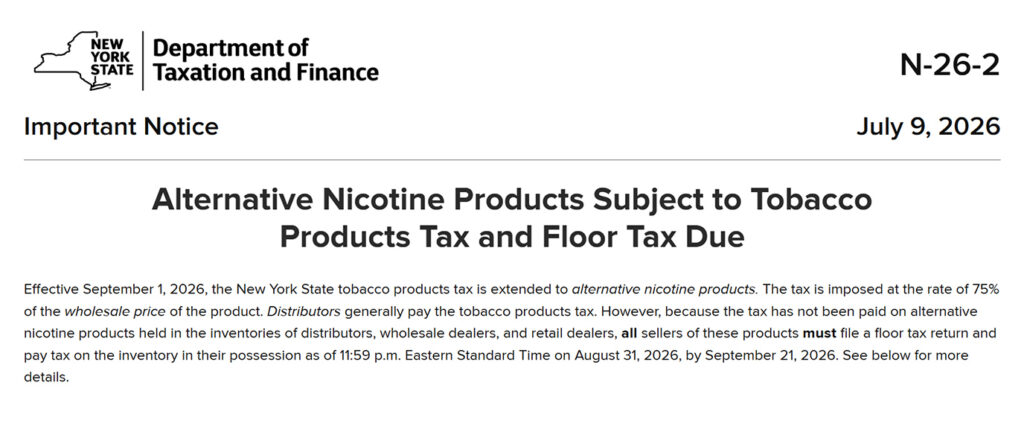
New York State Department of Taxation and Finance announced that New York State will extend its Tobacco Products Tax to Alternative Nicotine Products (ANPs) starting September 1, 2026. Under this new tax rule, taxable ANPs will be subject to a tax of 75% of their wholesale price, and distributors generally remain responsible for such tax payment. All distributors, wholesale dealers, and retail dealers currently holding ANP inventory must also file a floor tax return and pay tax on existing inventory by September 21, 2026.
Table of Contents
What Are Alternative Nicotine Products

Under New York State law, Alternative Nicotine Products (ANPs) are noncombustible products that contain nicotine but no tobacco, and are used by adult consumers through chewing, dissolving, absorption, or other forms of ingestion. Examples may include nicotine pouches, nicotine gum, and other oral nicotine products that meet the state’s definition.
Importantly, ANPs do NOT include vapor products, such as electronic cigarettes, disposable vapes, pod systems, and other electronic nicotine delivery systems. They also exclude products regulated by the U.S. Food and Drug Administration (FDA) as drugs or devices under 21 U.S.C. § 351 et seq. For example, certain FDA-regulated smoking cessation drugs and devices are not considered alternative nicotine products under this law.
Who Must Comply With the New York Nicotine Pouch Tax
Starting September 1, 2026, any person or business involved in importing, distributing, wholesaling, or selling nicotine pouches in New York State will be required to comply with the state’s new tobacco products tax requirements.
The persons or businesses may include:
- Distributors
- Wholesale dealers
- Retail dealers
They must complete registration, tax payment, inventory reporting, and recordkeeping requirements.
(1) Registration Requirement
Any person or business importing or selling nicotine pouches in New York State must be licensed or registered as a tobacco products distributor, wholesale dealer, or retail dealer before the NY nicotine pouch tax takes effect on September 1, 2026.
A distributor generally refers to any person or business that imports tobacco products into New York for sale, manufactures tobacco products in the state, or is authorized by the New York State Department of Taxation and Finance to file returns and pay tobacco product taxes on taxable products sold, shipped, or delivered in the state.
It is important to note that any person or business importing more than fifty cigars, one pound of tobacco, or fifteen units of nicotine pouches and other oral nicotine products for sale may be considered a distributor and subject to tobacco tax compliance requirements.
A “unit” refers to each package or container in which an alternative nicotine product is sold or distributed to consumers, including canisters, packs, boxes, cartons, or other types of packaging.
Additionally, distributors, wholesale dealers, and retail dealers who already hold a valid tobacco products license or registration with the New York State Tax Department do not need to register again to sell nicotine pouches.
(2) Tobacco Products Tax Payment
Beginning September 1, 2026, New York State will extend its tobacco products tax to nicotine pouches and other oral nicotine products, with the tax imposed at a rate of 75% of their wholesale price.
Under this tax rule, the wholesale price is the price at which tobacco products are sold to a distributor before any discounts, rebates, trade allowances, or other reductions are applied. Also, federal excise taxes paid by the seller are included when determining the wholesale price. A distributor’s purchase invoice is considered presumptive evidence of the product’s wholesale price.
(3) Floor Tax on Existing Inventory
Since oral nicotine products (e.g., nicotine pouches) held before September 1, 2026 were not subject to the tobacco products tax, distributors, wholesale dealers, and retail dealers with existing inventory must pay the corresponding floor tax.
They must:
- Conduct a physical inventory of all ANP units in their possession as of 11:59 p.m. Eastern Standard Time on August 31, 2026;
- File Form MT-200.5, Alternative Nicotine Products Floor Tax Return, and pay the floor tax of 75% of the wholesale price of these units by September 21, 2026.
If distributors, wholesale dealers, and retail dealers store nicotine pouches at multiple locations, they must file one consolidated floor tax return and report inventory for each location on Form MT-200.5, Schedule A.
The floor tax requirement also applies to ANPs stored in vending machines. Operators must complete a physical inventory of vending machines whenever possible or estimate inventory based on one-half of normal fill capacity when a physical count is unavailable. Vending machine and warehouse inventory must be reported on Form MT-200.5, Schedule B.
For floor tax calculations, retail dealers may use 50% of the retail selling price (excluding sales tax) of the taxable oral nicotine products as the wholesale price.
(4) Inventory Records and Tax Compliance
Distributors, wholesale dealers, and retail dealers that store or sell oral nicotine products must maintain accurate inventory and tax records, and make them available for inspection by the New York State Tax Department.
Required records include:
- Original inventory reports maintained at each business location;
- Physical inventory records used to calculate the ANP floor tax due;
- Supporting documentation used for tax reporting.
If they fail to file Form MT-200.5 or pay the required floor tax by September 21, 2026, they may face interest charges and civil or criminal penalties from the New York State Tax Department.
Impacts on Nicotine Pouch Users

New York Nicotine Pouch Tax not only reflects a regulatory trend, but also creates new compliance requirements for distributors, wholesale dealers, and retail dealers who sell nicotine pouches. They must pay closer attention to product classification, inventory tracking, wholesale price calculation, registration, and tax reporting requirements.
The 75% tax based on wholesale prices may increase costs throughout the nicotine pouch supply chain. While the final impact will depend on how sellers adjust their pricing strategies, nicotine pouch users may see higher retail prices for nicotine pouches and other oral nicotine products after the new tax rule takes effect.
For regular nicotine pouch users, the new NY nicotine pouch tax may also affect product affordability, brand selection, and purchasing habits. Some consumers may consider stocking up on their preferred nicotine pouches before the new tax takes effect on September 1, 2026 to reduce the impact of potential price increases in the future.